Pima County
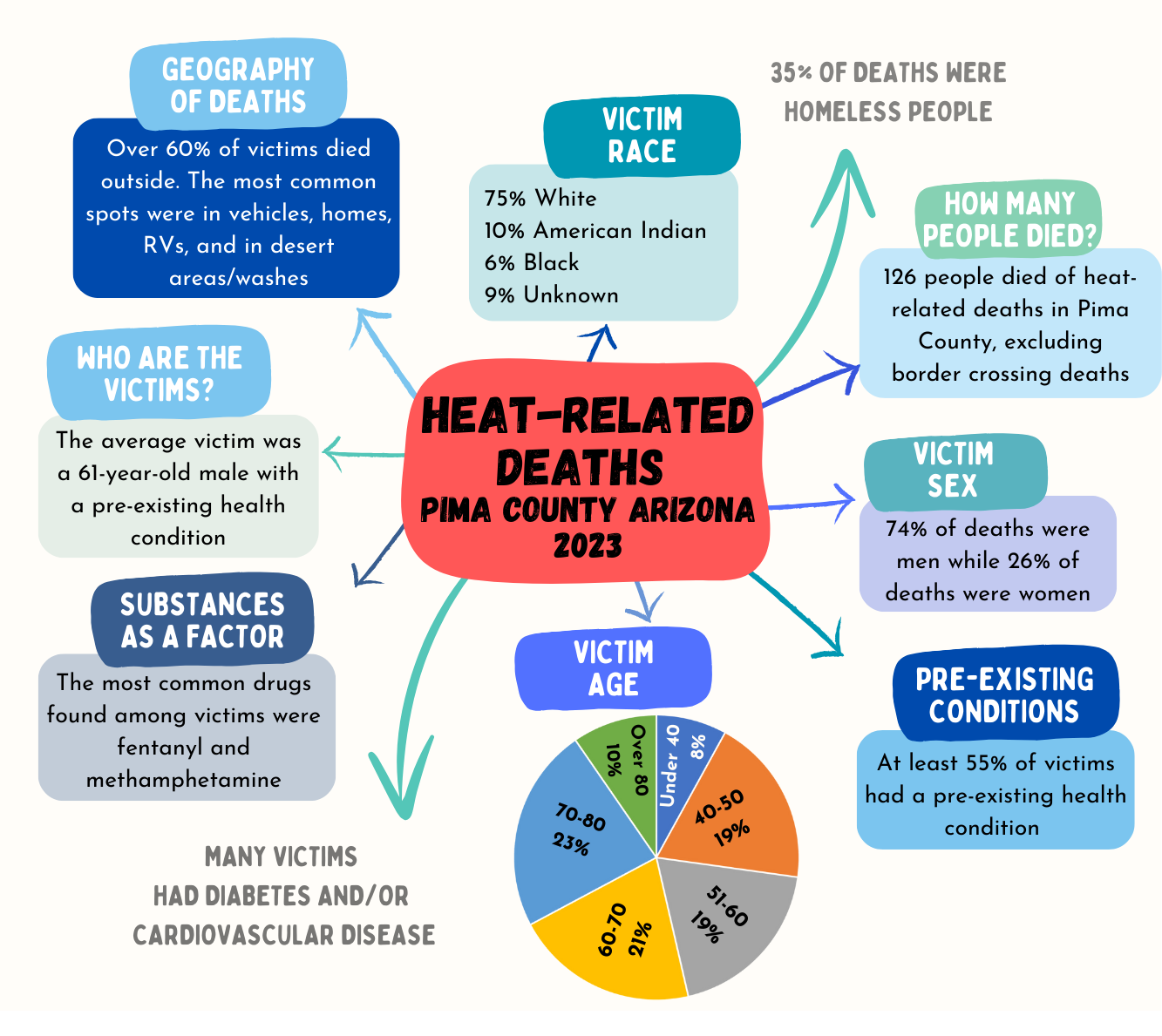
Pima County (Tucson) is also experiencing an epidemic of heat-related deaths. There were 126 heat-related deaths in the county in 2023[15], even excluding 50 heat-related deaths of undocumented border crossers, who died after crossing Pima County’s 125-mile rural border with Mexico.
Although 2023 was the first year that Pima County published a count of heat-related deaths, the county has tracked heat-caused deaths since 2010. While comparing the trend in heat-caused deaths in Pima County to the trend in heat-related deaths in Maricopa County is not exactly an apples-to-apples comparison, heat-caused deaths in Maricopa County have shown a fairly stable relationship with heat-related deaths: heat-caused deaths have comprised between 50% and 70% of heat-related deaths in each of the last ten years. Therefore, we believe that the trend of heat-caused deaths in Pima County has likely been accompanied by a similar but unrecorded trend of heat-related deaths.
Trend in heat-caused deaths
In 2023, there were over 50% more heat-caused deaths in Pima County (43) than the previous record in 2022 (28), and more than double any year before 2022. Notably, 2023 more than doubled 2020 even though it wasn’t quite as hot. Adjusting for population growth in Pima County—about 8.5% since 2010—the death rate in 2023 was still several times the rate in most previous years.
Although the trend before 2020 is unclear in the chart above, the trend since is unmistakably upward. It appears that Pima County heat-caused deaths may be increasing in a pattern characteristic of exponential growth, similar to that in Maricopa County. Given that there were so many more heat-caused deaths in Pima County in 2023 than in any previous year, we believe that the 126 heat-related deaths in 2023 were very likely the most ever in the county.
Victim demographics
Characteristics of Pima County victims in 2023 were similar to those in Maricopa. Nearly three-fourths of the victims were men, around 70% were over 50, and over 50% had chronic health conditions. Whites, who make up almost 85% of the population in the county, comprised 75% of the victims; racial minorities were overrepresented among the victims. Over 60% of deaths happened outside. Perhaps the most notable differences were that only 35% of victims were classified as homeless (vs. 45% in Maricopa), and only 40% of deaths involved drugs (vs. 65%). Methamphetamine was the most common drug involved, with fentanyl a distant second.
Increasing temperatures in Pima County
It’s likely that the heat-related death rate has increased in Pima County for the same general reasons it has in Maricopa: worsening urban heat in the summer, and increasing vulnerability in the population due to factors such as unsheltered homelessness. Tucson’s summer average median temperatures are getting hotter, just like Phoenix. While Tucson has not warmed as much as Phoenix over the past hundred years (+4.1 degrees vs. +7.4 in Phoenix), it may have warmed more than Phoenix since 2001, according to the respective short-term trend lines (+2.7 degrees in Tucson vs. +1.6 degrees in Phoenix).
Population vulnerability
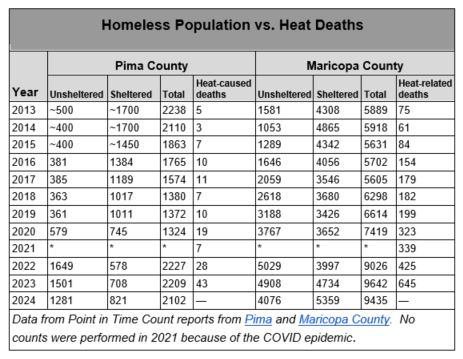
Unsheltered homelessness levels were stable or even declining before 2019 in Pima County, and there was no clear increase in heat-caused deaths from 2013 through 2019. Then in 2020, unsheltered homelessness began to climb quickly, and so did heat-caused deaths. This follows a similar pattern in Maricopa County, where the increase in heat-related death rate beginning in 2015 corresponded with an increase in unsheltered homelessness that also began in 2015.
Heat-related deaths involving methamphetamine and/or fentanyl, though somewhat lower than in Maricopa County, still accounted for 40% of all heat-related deaths in Pima County in 2023, and intensifying methamphetamine and fentanyl usage is likely a major factor in increasing heat-related death rates. Overdose deaths in general have doubled in the past decade in Pima County, indicating more widespread and/or intense usage and addiction. Most of the increase in overdose deaths has occurred since 2019, primarily from deaths involving fentanyl, which doubled between 2019 and 2022, and methamphetamine, which tripled. Pima County law enforcement officials have also reported the local methamphetamine supply transitioning to highly pure “super meth” over the past several years, which has likely contributed to increased deaths.
Like in Maricopa County, Pima County housing costs have outpaced wages, likely causing financial stress, health issues, evictions, and homelessness. Average home prices more than doubled from 2010 to 2023, as did average rent payments. Meanwhile, the average weekly wage increased only 34%. More than a third of Pima County households, and more than half of renters, pay 30% or more of their income towards housing costs—likely rendering many unable to easily pay for other necessities, like food, health care, or air conditioning.
The heat-related death rate in Pima County in 2023 (117.6 deaths per million people) was almost as high as Maricopa County (140.2), despite the fact that the average median summer temperature was about seven degrees cooler. This suggests that Pima County’s population is much more vulnerable than Maricopa County’s population. Our heat-related death model for Pima County in 2023 reflects this fact via an expected death rate that is much higher than the 2023 Maricopa County model at any given temperature.
As an experiment, we applied the 2023 Pima County model to 2023 Phoenix temperature data, and it predicted that 775 heat-related deaths would have occurred in Pima County at the temperatures Phoenix experienced. That would be 130 more deaths than Maricopa County suffered, despite the fact that Pima County has less than a quarter of the population.
We have not identified why Pima County’s population is more vulnerable to heat than Maricopa County. Contributing causes might include Pima County’s higher unsheltered homeless rate and lower incomes. Perhaps Maricopa County’s population is simply acclimatized to its hotter summers. More research would be needed to identify the reasons for the disparity in vulnerability.
[15] Our analysis is based on a data set we received from the Pima County Medical Examiner’s Office that includes 125 heat-related deaths in 2023 in Pima County. Pima County has since reported an additional death for 2023 that is not included in our analysis.