POLICY IMPLICATIONS
We do not have all the answers for how to reduce heat-related deaths. We will elaborate only on a handful of policies we have previously researched that address housing costs and the urban heat island effect—even though emergency measures would likely save more lives in the short term. Simply closing the gap between the homeless population and shelter capacity would save many lives, and in fact both Phoenix and Tucson have begun taking steps to do so—over 800 new beds in Maricopa County alone. Policies that address social vulnerabilities like substance abuse are beyond our expertise but also deserve considerable attention.
We focus below on policies related to the built environment as it is the area we have the most to contribute. Built environment is a broad term that refers to all the physical parts of a city, such as streets, buildings, parks, and even plants and non-man-made components. Public policy shapes nearly every aspect of the built environment including the availability of housing and the prevalence of heat-aggravating surfaces.
Heat
Policies targeting the built environment can reverse the urban heat island effect or even produce localized “cool island effects” making places cooler than they were prior to warming.
Although many materials and activities cause urban heat island effects, impervious surfaces that absorb sunlight and radiate heat—such as asphalt and concrete—are the largest contributors in Phoenix. Asphalt streets can be 40-60° hotter than surrounding air on hot summer days. Indeed, one Phoenix hospital reported 85 hospital admissions and seven deaths just from contact burns in summer 2022.
Greater Phoenix is a sprawling metropolis, and for many residents driving is the only convenient transportation option. Streets are necessary. However, there is considerable room for improvement even without remaking the transportation system or sacrificing convenience.
Parking laws
Forty percent of Phoenix’s entire urban land area is paved. Most of this pavement is legally required in some way, but that can be changed. One reason cities have so much pavement is that zoning laws effectively require it via intricate rules for private land use, especially parking requirements. For example, Phoenix’s zoning ordinance requires all parking spaces other than for single-family and duplex driveways to be paved with a hard surface
About 10 percent of the Phoenix metro area is dedicated to parking alone. Almost all residential streets provide parking on both sides though most street parking remains empty most of the time16. And additional off-street parking is generally required. For example, every city in the Phoenix metro area requires at least two parking spaces per single-family home. A 2017 study estimated that the supply of residential parking in Phoenix considerably exceeds demand, with roughly three residential parking spaces for every registered private vehicle. Commercial zoning often requires parking lots with dozens or even hundreds of spaces that similarly go unused most of the time.
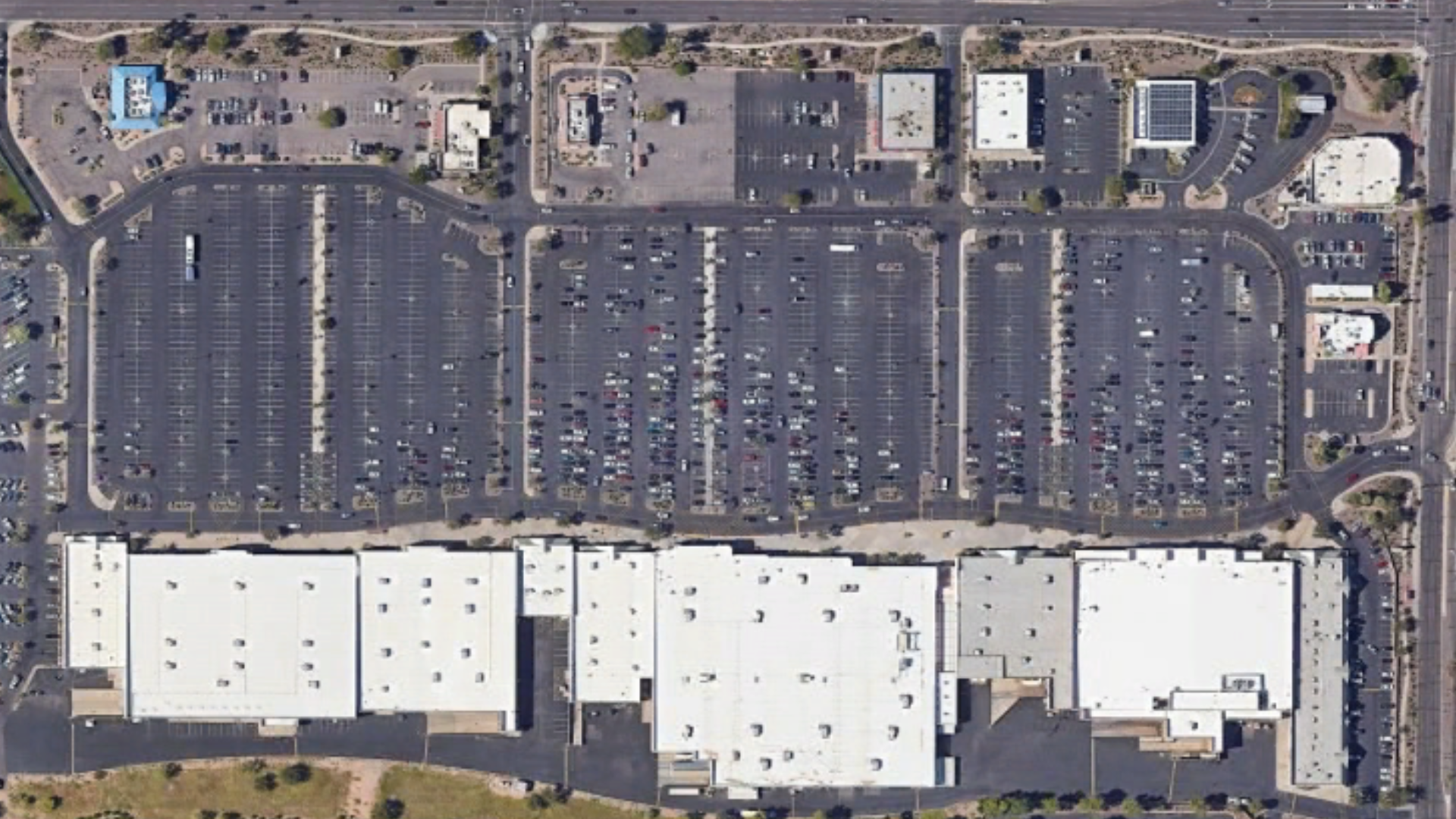
Even if people continue to drive most places, we could reduce the number of spaces considerably and still park conveniently most of the time. Cities should at least consider reducing parking minimums to more closely align with demand and use. Beyond that, it's worth considering eliminating parking requirements for private land altogether. Developers, business owners, and homeowners can likely predict parking demand more accurately than a one-size-fits-all ordinance, and they can also adjust when demand changes or their estimates are off.
Paved public infrastructure
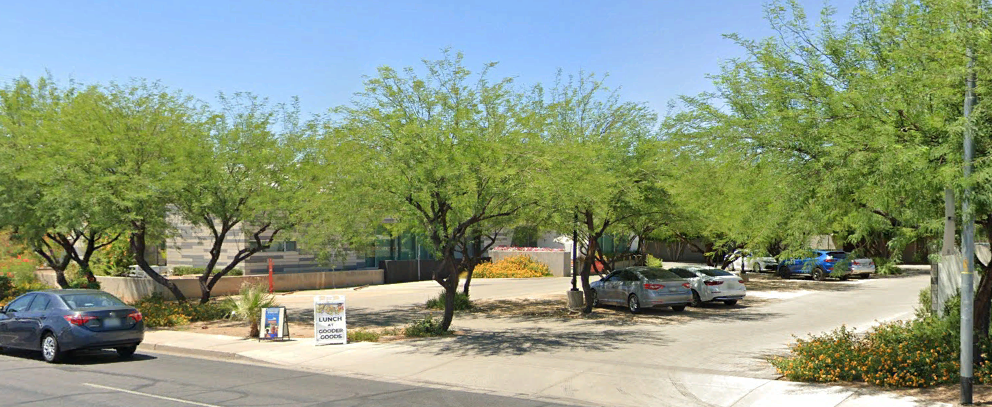
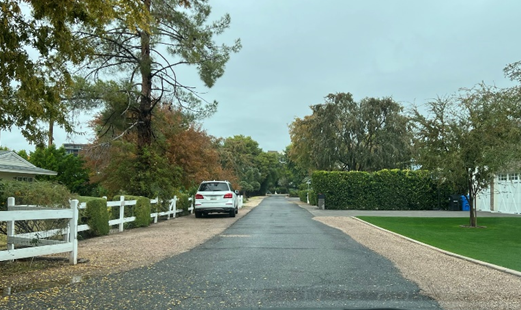
Cities may be able to considerably reduce paved street area without impeding traffic flow by identifying situations where laws or street standards call for more pavement than necessary. For example, vehicles may fully utilize the pavement on freeways and arterial roads. But what about Phoenix’s 3,500 miles of local streets? The city requires these streets to be at least 28 feet wide. Most are located in quiet residential neighborhoods, where full-width asphalt may not be necessary for traffic flow, parking, or emergency vehicle access. For example, the portion used for parking on the sides of many streets could be replaced with a cooler, unpaved surface, similar to the image on the right below. And street width requirements themselves, many of which have existed for decades, should be reconsidered in light of worsening urban heat island effects. Narrow streets also have the side benefit of slowing traffic through neighborhoods.
Trees as public green infrastructure
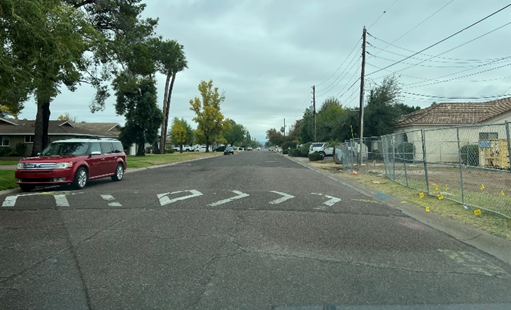
The cooling impact of trees is impressive. Shade can decrease how hot it feels by up to fifteen degrees. A study found that trees cool local daytime temperatures more effectively than cool roofs 17. And native desert trees require relatively little water—Phoenix could irrigate a million trees with about 0.5% of its current water usage.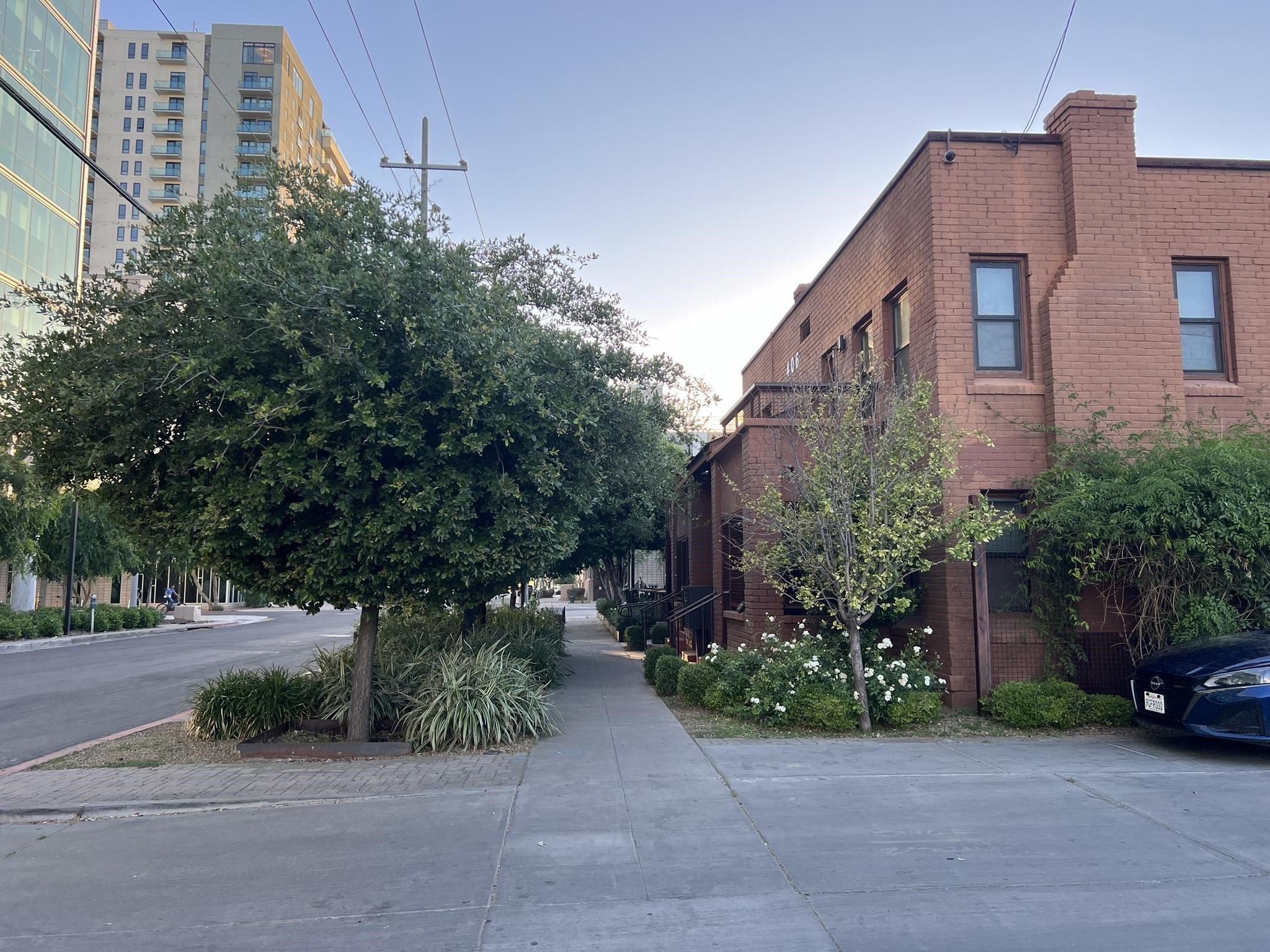
Generally, cities have a few options to increase tree canopy: 1) establish tree requirements for privately-owned land; 2) provide incentives, such as offering free trees; and/or 3) plant trees on public land. The first option is inexpensive, but usually involves zoning or other requirements that entangle the city with private property in ways some owners find meddlesome and can obligate property owners to maintain a public good—which some cities have learned they do not always do effectively. Option two avoids the drawbacks of option one but depends on voluntary participation.
The third option may provide the most consistent coverage, especially if trees are incorporated into public right-of-ways as green infrastructure. Many cities have taken this approach, including Tucson, Boise, and Cincinnati. Because trees are particularly effective at cooling narrower streets, this policy may be doubly effective when combined with street narrowing and depaving.
Cooling the places humans spend time
Tree shade provides a great deal of cooling benefit at the very local level. Thoughtfully placing trees and combining them with other heat-mitigating measures can make pedestrians, cyclists, and micro-mobility users more comfortable and provide places for people to safely rest out of the sun. A connected network of shaded corridors throughout a city may provide significantly more benefit than alternatives that achieve a higher percentage of tree canopy coverage without thoughtful placement. Such a connected network could be particularly helpful for seniors, children, and others who do not drive. 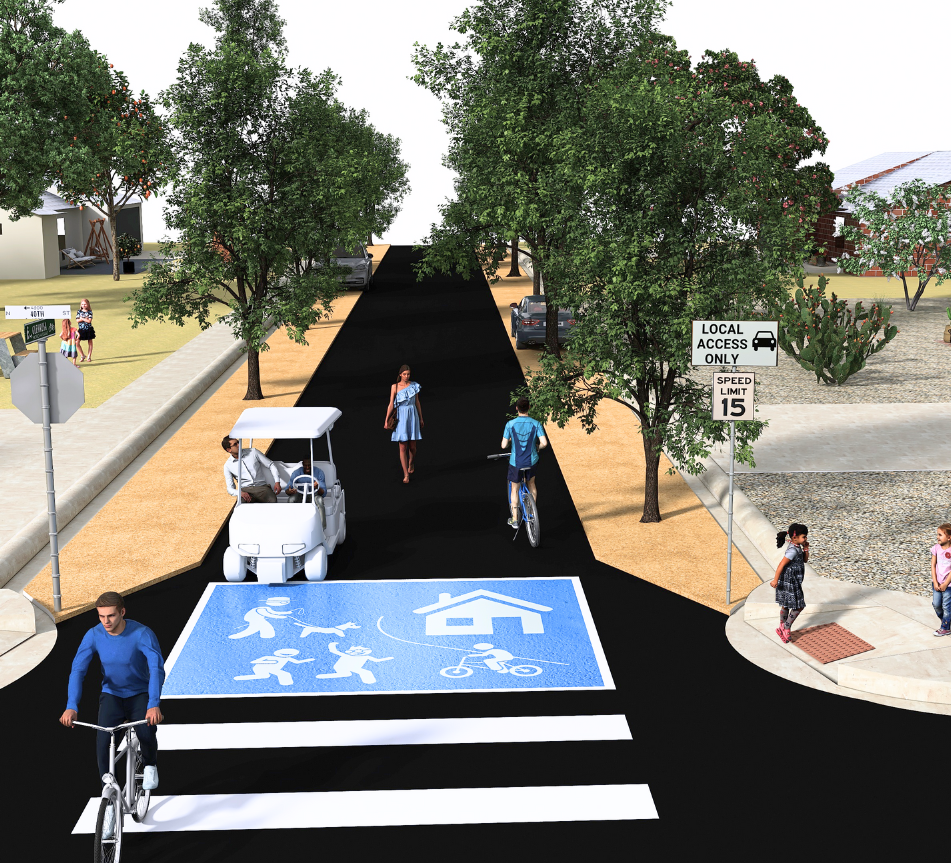
"Cool" pavements and roofs
One promising strategy is to convert to “cool” surfaces that reflect sunlight rather than absorb it. Cool pavement lowers surface temperature and may be useful to reduce a city’s overall urban heat island effect. It may not be suitable for areas used by pedestrians, however, because it is less effective at cooling the air right above it and reflects sunlight onto pedestrians, heating them rather than cooling them
Cool roofs have the same benefits as cool pavement without affecting pedestrians. One study in the United Kingdom found that widespread adoption of cool roofs could reduce heat-related deaths associated with the urban heat island effect by 18%.
Reducing vulnerabilities related to housing
A severe housing shortage in Arizona has caused prices to soar, which in turn has caused vulnerabilities like homelessness and financial stress. The Arizona Department of Housing estimates that the state has a shortage of around 270,000 units. A low-income person is much more likely to become homeless if they live in a city with a shortage of housing18. The housing market is one of the most complex parts of the economy. In addition to local supply, housing costs are also affected by factors including federal policy and far-away financial institutions trading mortgages on secondary markets. But the supply of homes is controlled almost entirely by local laws.
Zoning laws
Zoning laws prevent housing units from being created. In many cities, 70-90% of residential land is zoned for single family homes, where the number of homes allowed is generally fixed—no new homes allowed. Multifamily zones thus usually must absorb new growth in existing neighborhoods. But zoning often prevents multifamily housing for low income people, such as single-room occupancies (SROs)—a housing arrangement with shared bathrooms similar to college dormitories. SROs historically kept people out of homelessness, but are now illegal in entire cities 19. Almost all new housing in the U.S. takes one of two forms: big houses—almost 90% of new homes have three or more bedrooms—or large multi-family developments, which are often expensive—the median price of a new condo rose to $550,000 in 2023.
This creates a big mismatch between what households need and the types of homes that are available. Two-thirds of American households have two or fewer people, and many households have modest incomes. “Missing middle” housing—smaller units ranging from casitas or mother-in-law-suites, to duplexes and small courtyard apartments—is often prevented by current zoning but could provide more units of affordable housing suitable for small households. Missing middle housing was ubiquitous across the country before 1940, but made up less than 10% of new units in the 2010s. In most instances, missing middle is less expensive to build because it spreads the cost of land between multiple households while still relying on simple and inexpensive construction techniques.20
Housing is often entirely prohibited on land zoned for commercial or industrial use. And zoning laws often prevent low-cost construction techniques such as prefabrication, and require high cost features like minimum lot sizes, enclosed garages, and aesthetic details. Finally, zoning laws often impose cumbersome approval processes and extensive public input that adds fixed costs and makes many smaller projects infeasible.
Incremental development of missing middle housing historically scaled surprisingly well before such restrictive zoning laws existed. Small developers built almost every American city before the Great Depression. Chicago grew by 9% each year throughout the 19th century with largely small-scale development. Small developers built iconic neighborhoods of missing-middle housing, such as two-flats in Chicago and the Brooklyn brownstones. And there is evidence that more missing middle housing would be built today if restrictions were removed. For example, Los Angeles has had a boom in ADU construction—25% of all new home permits in 2022–after they were legalized.21
Arizona cities have begun enacting various reforms, and the state recently enacted a bill legalizing one attached and one detached accessory dwelling unit (ADU) on all single-family lots in cities with more than 75,000 people. This includes guest houses and granny flats, which may rent for lower prices than apartments. The legislature also enacted a bill allowing up to fourplexes on all single-family lots near downtown areas of many cities. These are great first steps, hopefully the first of many, to help make housing more plentiful and affordable.
Messaging
Potential policy disagreements related to heat, housing, and the built environment can arise from philosophical and linguistic framing, short-circuiting potential agreement on the actual policies. In 2022 for example, the Biden Administration’s Build Back Better Act included a “tree equity” provision designed to favor underserved communities in $3 billion in grant funding for increasing tree canopy and other heat mitigation measures. The provision provoked charged opposition because some viewed the word “equity” as shorthand for policies that they felt unfairly enforced equal outcomes in lieu of equal opportunity. The bill eventually passed, but the final version included much less tree funding. A policy that instead focused on planting trees in places with low tree canopy would likely have had a similar impact with less controversy.
We therefore recommend using neutral words and literal descriptions when advancing policies. If disputes over loaded terms are avoided, we are optimistic that major policy shifts are feasible.
FINAL THOUGHTS
Many of the policies that will lower the heat-related death rate help solve broader problems. For example, reducing housing costs will make all living expenses more affordable for those with modest incomes. And reducing the urban island effect won’t just save lives; it will keep many from becoming ill, and allow residents now stuck inside for much of the year to enjoy healthy outdoor activities more often. Reducing the urban heat island effect could also decrease the perception that southern Arizona cities will not be habitable in the long term, which may have increasing negative economic consequences for the region. Instead, southern Arizona could be recognized as a region that is creatively solving big challenges to ensure a vibrant future.
[16] A house on a 110 foot wide lot may have four or five on-street parking spaces in front of it. The average U.S. household has 2.3 cars. A 2017 study estimated that in the Phoenix metro area only about 23% of available parking spaces are filled on average.
[17] Ariane Middel, et al., Urban forestry and cool roofs: Assessment of heat mitigation strategies in Phoenix residential neighborhoods, 14(1) Urban Forestry & Urban Greening 178–186 (2015).
[18] Colburn and Aldern studied a variety of factors associated with homelessness and found that a shortage in housing supply is the biggest predictor of which cities have the highest rates of homelessness. Gregg Colburn & Clyaton Page Aldern, Homelessness Is a Housing Problem 13 (2022).
[19] Charles Marohn & Daniel Herriges, Escaping the Housing Trap: The Strong Towns Response to the Housing Crisis 156 (2024).
[20] Id. at 92-93
[21] Id. at 131