 Learn About Educational Attainment Rates in Tucson, Arizona MSA
How are we doing?
Four-Year College Attainment Rate (2024)
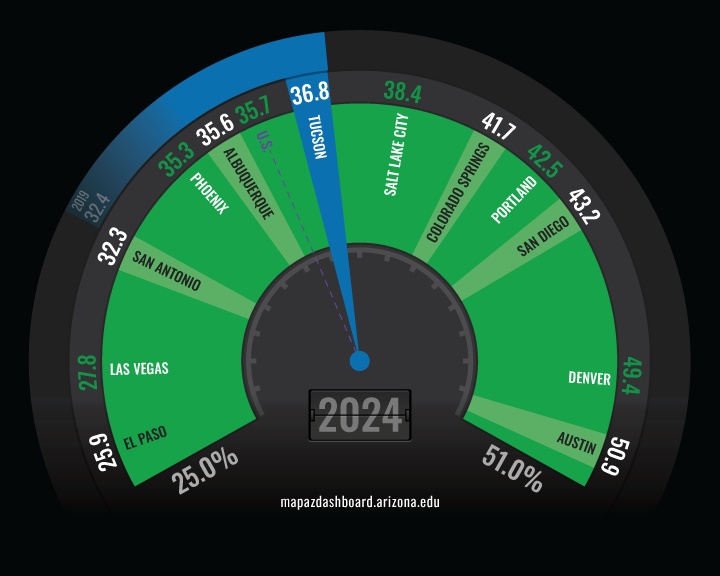
In 2024, the Tucson Metropolitan Statistical Area (MSA) ranked near the middle among 12 peer western MSAs in four-year college attainment. In Tucson, 36.8% of the population age 25 and older had a bachelor’s degree or higher. That share was well below Austin, which ranked first at 50.9%. Since 2019, Tucson’s college attainment rate for the working-age population has increased by 4.4 percentage points, reflecting steady gains across the region.
Why is it important?
Educational attainment is a key driver of long-run income, job, and population growth. Regions with a higher share of college-educated residents generally perform better across many socioeconomic indicators, including lower poverty and unemployment rates, higher productivity, and lower crime rates. Research shows that less educated residents also tend to earn higher wages in regions with higher concentrations of college graduates.
How do we compare?
In 2024, the Tucson MSA had a smaller share of residents with a high school degree as their highest level of education at 21.1%, compared to the U.S. at 26.0%. In contrast, Tucson had a larger share of residents with some college, but no degree, at 23.4% compared to the nation at 19.1%. Tucson also exceeded the U.S. share of residents with a graduate or professional degree, at 16.0% versus 14.1% nationwide. In part, this reflects the presence of the University of Arizona and its role in attracting advanced-degree holders.
Educational attainment rates vary significantly by race and ethnicity. In 2024, college attainment rates were highest among Asian residents in Tucson, Arizona, and the U.S. Rates were generally lower for American Indians, Hispanics, Native Hawaiian and Pacific Islander, and other races. In Tucson, 21.0% of Hispanic residents age 25 and older had a bachelor’s degree or higher in 2024. That rate was above the Arizona rate and nearly equal to the national rate. However, it remained well below the rate for white, non-Hispanic residents in Tucson, which was 45.1%. Among white, non-Hispanic residents age 25 and older, Tucson's college attainment rate exceeded the national rate by 5.6 percentage points.
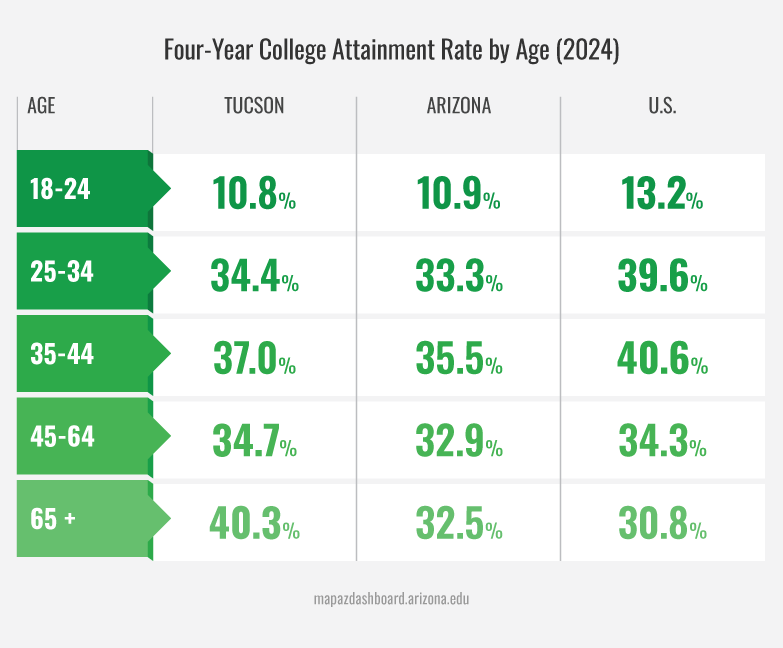
College attainment rates also vary notably by age. In 2024, the share of Tucson residents with a bachelor’s degree or higher was highest for those age 65 and older, at 40.3%. For younger working-age residents (ages 25-34 and 35-44), Tucson’s college attainment rates were well below the national average. In contrast, among residents age 65 and older, Tucson exceeded the national rate. This is in part influenced by migration to the region, which has tended to attract retirees with higher levels of education. Also notable in 2024, Tucson’s residents ages 45-64 exceeded the national average in college attainment.
What are the key trends?
The Tucson MSA college attainment rate has increased steadily since 2000, although growth has trailed the nation. The share of residents age 25 and older with a bachelor’s degree or higher rose from 26.7% in 2000 to 36.8% in 2024, a 10.1 percentage point increase. By comparison, the nation increased by 11.3 percentage points over the same period. However, more recently, Tucson’s gains in college attainment have outpaced the nation, with stronger growth over the past five years.
How is it measured?
Educational attainment reflects the share of the population age 25 and older with a given level of education. Respondents report the highest level of education completed. The data come from five-year estimates for 2009, 2018, and 2023 from the U.S. Census Bureau’s American Community Survey (ACS). Note that the ACS five-year estimates are a rolling survey taken over five years. Therefore, they are only comparable at five-year intervals. Data for 2000 are drawn from the 2000 Census Summary File 3.
In academic year 2023–2024, postsecondary institutions in Utah awarded 520.8 degrees and certificates per 10,000 adults (abut 5.2% of adults), the highest rate among the western states. Arizona ranked second at 314.9 awards per 10,000 adults, while Nevada posted the lowest rate at 117.2. Nationally, institutions awarded 67.7 degrees and certificates per 10,000 adults.
Between 2006 and 2024, the rate of degrees and certificates awarded per 10,000 adult residents increased in most western states. Arizona rose from 236.1 in 2006 to 314.9 in 2024, with particularly rapid growth between 2009 and 2012, when the rate climbed sharply and peaked at 429.2. Utah experienced the largest overall increase, rising from 247.4 in 2006 to 520.8 in 2024. Washington was the only state to record a decrease over the period, falling by 18.2 percentage points, from 162.5 in 2006 to 144.3 in 2024. Data for academic year 2019–2020 are unavailable due to COVID-19–related disruptions, so it is not possible to assess the full impact of the pandemic on degree and certificate awards.